
Why most "AI features" should be a button
Most of the AI bolted into products in 2026 makes them worse, not better. Here is when to ship it and when to walk away.
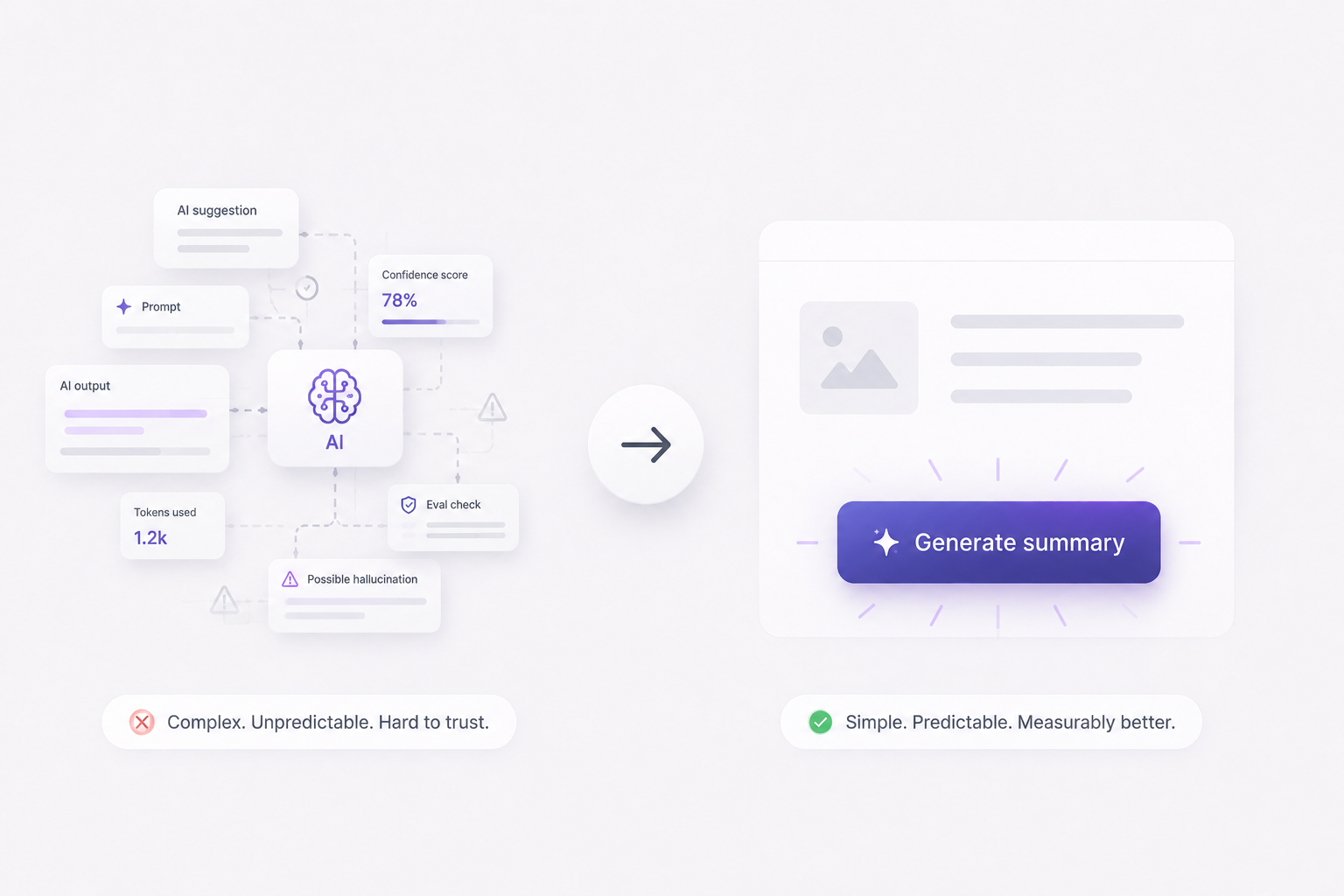
The pattern
Every product team’s inbox is full of “add AI to our product” requests. Most of them are bad ideas.
The bar for adding AI to an existing product isn’t “can we make it work”; the bar is “is this measurably better than the deterministic version a competent product designer would ship.”
A simple test
Before building an AI feature, write down the deterministic version. Often, the deterministic version is a button.
A button doesn’t hallucinate. A button doesn’t burn tokens. A button doesn’t degrade silently. A button doesn’t need an eval harness.
When AI earns its place
There are three patterns where AI consistently earns its place in production:
- Unstructured input → structured output: turning a paragraph into a row in a table, an image into a label.
- Open-ended generation that has a human reviewer: drafts, suggestions, summaries that a person decides to accept.
- Search and retrieval: finding the right document or fact, with citations.
When AI loses
Anything where the user could deterministically describe what they want. Anything where wrong answers are unsafe. Anything where the latency cost isn’t earned by quality.
If you can’t articulate the eval (“this AI feature is better than the alternative because X measurably improved”) you don’t have a feature. You have a demo.