Agentic AI in 2026: what actually changed, and what's still hype
A year of 'the year of agents' headlines later, here's what's genuinely different in production and what's still mostly a slide deck.
The claim worth checking
Every year since 2023 has been called “the year of agents” by someone with something to sell. That doesn’t mean nothing changed, it means the claim needs checking against what’s actually shipping, not against the keynote.
What’s genuinely different from two years ago
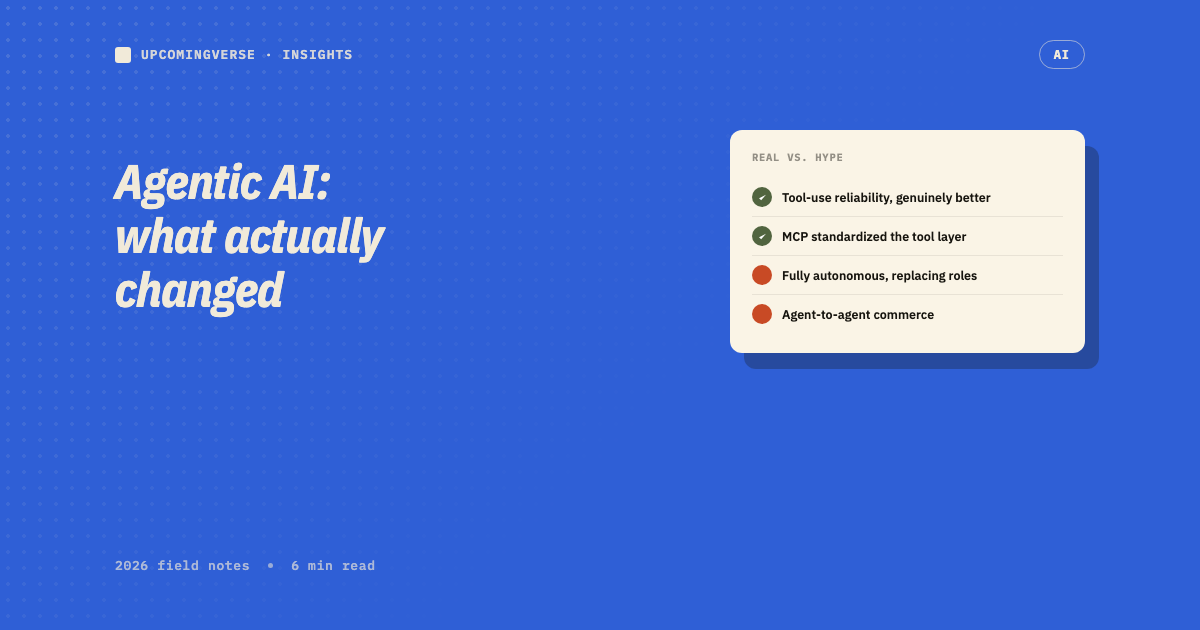
Tool-use reliability is meaningfully better. Models calling the wrong tool, malforming arguments, or giving up mid-task after a failed call used to be the default failure mode. It’s now the exception on current frontier and strong mid-tier models, which is the single biggest reason agent systems that would have been un-shippable in 2024 are running in production today.
MCP standardized the connection layer. Before the Model Context Protocol, every agent-to-tool integration was bespoke, every vendor had its own format, and switching models meant rewriting your tool layer. A standard protocol for exposing tools to a model is unglamorous infrastructure work, but it’s exactly the kind of boring standardization that makes an ecosystem actually usable instead of a pile of incompatible demos.
Multi-agent orchestration is less brittle. Planner-worker-critic patterns used to fail in ways that were hard to debug, one agent’s subtly wrong output would propagate silently through the rest of the pipeline. Better structured output, better evals tooling, and genuinely better model instruction-following have made these systems debuggable in a way they weren’t before.
What’s still mostly hype
“Fully autonomous” agents replacing entire job functions. What’s actually shipping is agents that take real, specific work off a person’s plate, not agents that eliminate the role. Every production agent we’ve built keeps a human in the loop somewhere, even when that loop is just reviewing a weekly digest instead of approving every action. The honest version of agentic AI in 2026 is leverage, not replacement, and the marketing gap between those two claims is wide.
Agent-to-agent commerce and autonomous negotiation. Technically interesting, essentially absent from any production system we’ve seen or built. The actual demand right now is agents that do one team’s specific job reliably, not agents transacting with other companies’ agents in some open marketplace.
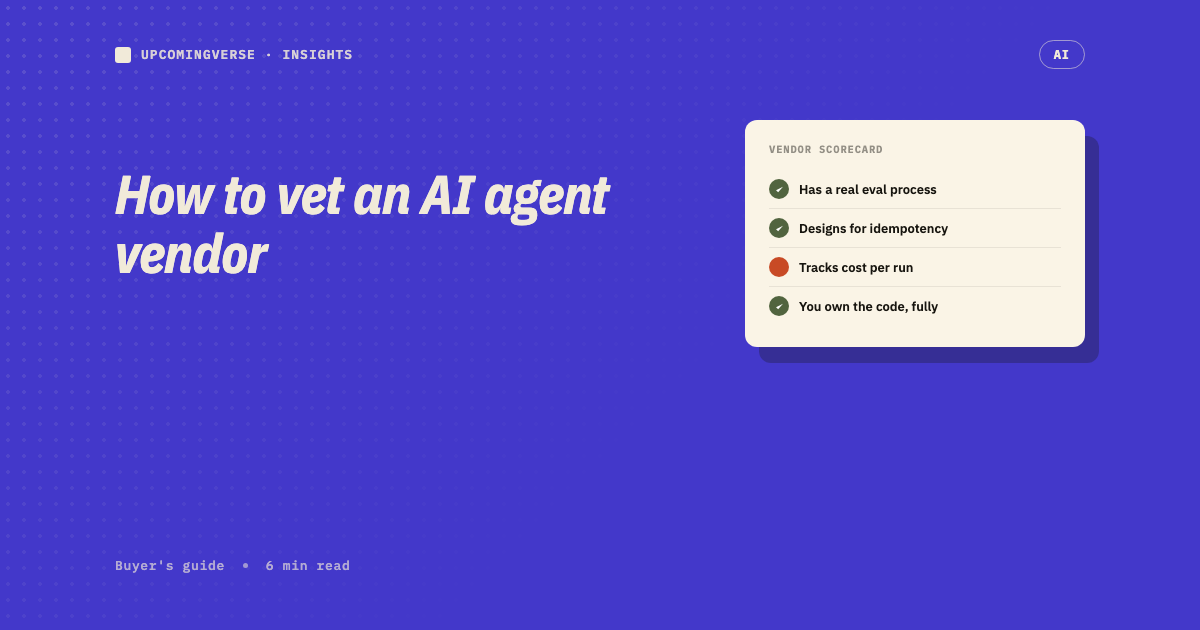
“No-code, fully autonomous agent builders” producing production-grade systems. The demos are real. The production-readiness usually isn’t, for the exact reasons we cover in the boring parts of an AI agent that actually matter: idempotency, cost tracking, and a real eval harness rarely come included, and that’s most of what separates a demo from something that survives a thousand real runs.
What we’re actually seeing work
Narrowly scoped agents with a clear job, a small number of tools, a human checkpoint sized to the stakes of the action, and a real eval suite that runs before every prompt change ships (see a short list of evals every LLM product should have). Nothing in that list is flashy. All of it is what makes the difference between a system that’s still running in six months and one that quietly got turned off after the third bad week.
Where it’s actually going next
More reliable tool use and better standardization mean the floor is rising, agent systems that were ambitious in 2024 are closer to routine now. The ceiling (genuinely autonomous, high-stakes, multi-system agents with no human checkpoint) is still further out than the hype suggests, and the honest move for most teams is to build for the floor that’s solid today, not the ceiling that’s still a few years out.