LLM apps, retrieval, fine-tuning, and AI features bolted into your existing product, without breaking what works.
We design and ship production-grade AI features into existing software. From RAG pipelines on your private data, to fine-tuned domain models, to embedded chat surfaces and inference cost engineering, we treat AI like the rest of your stack: testable, observable, on-budget.
AI Integration is about taking a product that already works and giving it a useful new layer: a chat surface, a smarter search, a draft button, an auto-classifier, a domain-specific copilot. We treat the AI piece the way we treat the rest of your stack: testable, observable, on a real budget, and ready to ship to paying customers.
Most of our integrations sit on top of OpenAI, Anthropic Claude, or Gemini, with self-hosted Llama / Mistral via vLLM when latency or compliance demand it. We pick the simplest pipeline that survives a real user, instrument it with evals from day one, and hand you the keys at the end.
02/ Capabilities
What we build.
→ 4 areas
What we build.
01
LLM applications
Chat, search, summarization, classification, and content workflows on top of OpenAI (GPT-5, GPT-4o), Anthropic Claude (Sonnet, Opus), Gemini, Llama, Mistral, or self-hosted models. Built with LangChain or the OpenAI / Anthropic SDKs directly when overhead is the enemy.
02
RAG & retrieval
Vector pipelines on your private data using Postgres + pgvector, Pinecone, Weaviate, or Qdrant. Hybrid BM25 + dense retrieval, cross-encoder reranking, grounded citations, eval harnesses you can run in CI.
03
Fine-tuning & evals
Domain-specific small models, LoRA/QLoRA, distillation, RLAIF. Eval harnesses with LangSmith, Braintrust, or hand-rolled pytest suites. Promptfoo for prompt diffing.
04
Vision & multimodal
OCR, image understanding, document AI, and voice using GPT-4 Vision, Claude Vision, Gemini, or fine-tuned ViTs. Production-deployed on AWS Bedrock, Vertex AI, or self-hosted vLLM.
03/ Use cases
Where this shows up.
→ 6 examples
Where this shows up.
Customer-facing chat & support
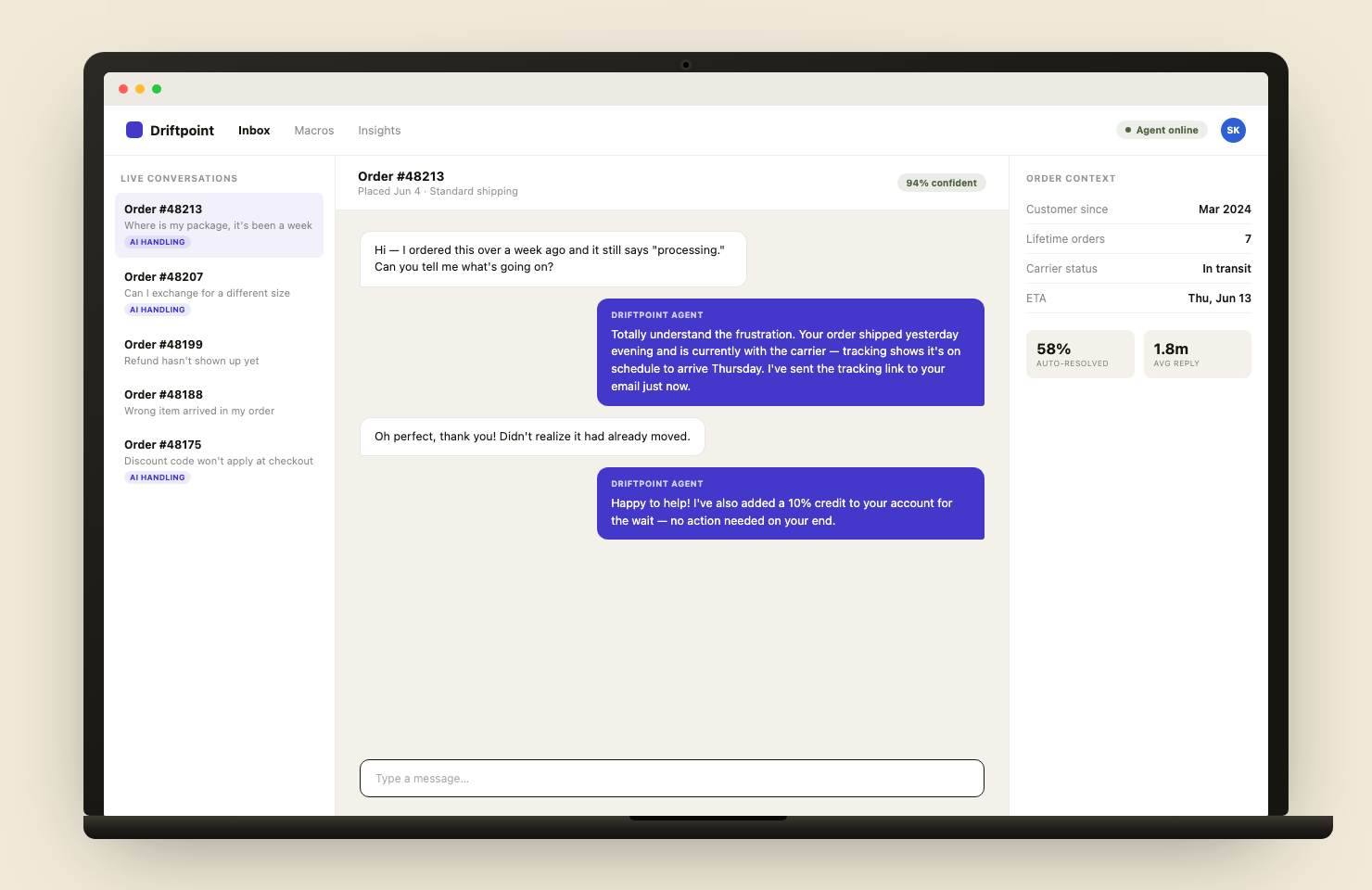
A grounded support assistant on your help docs and product. Citations, fallbacks, escalation to a human at the right moment.
Smart search & retrieval
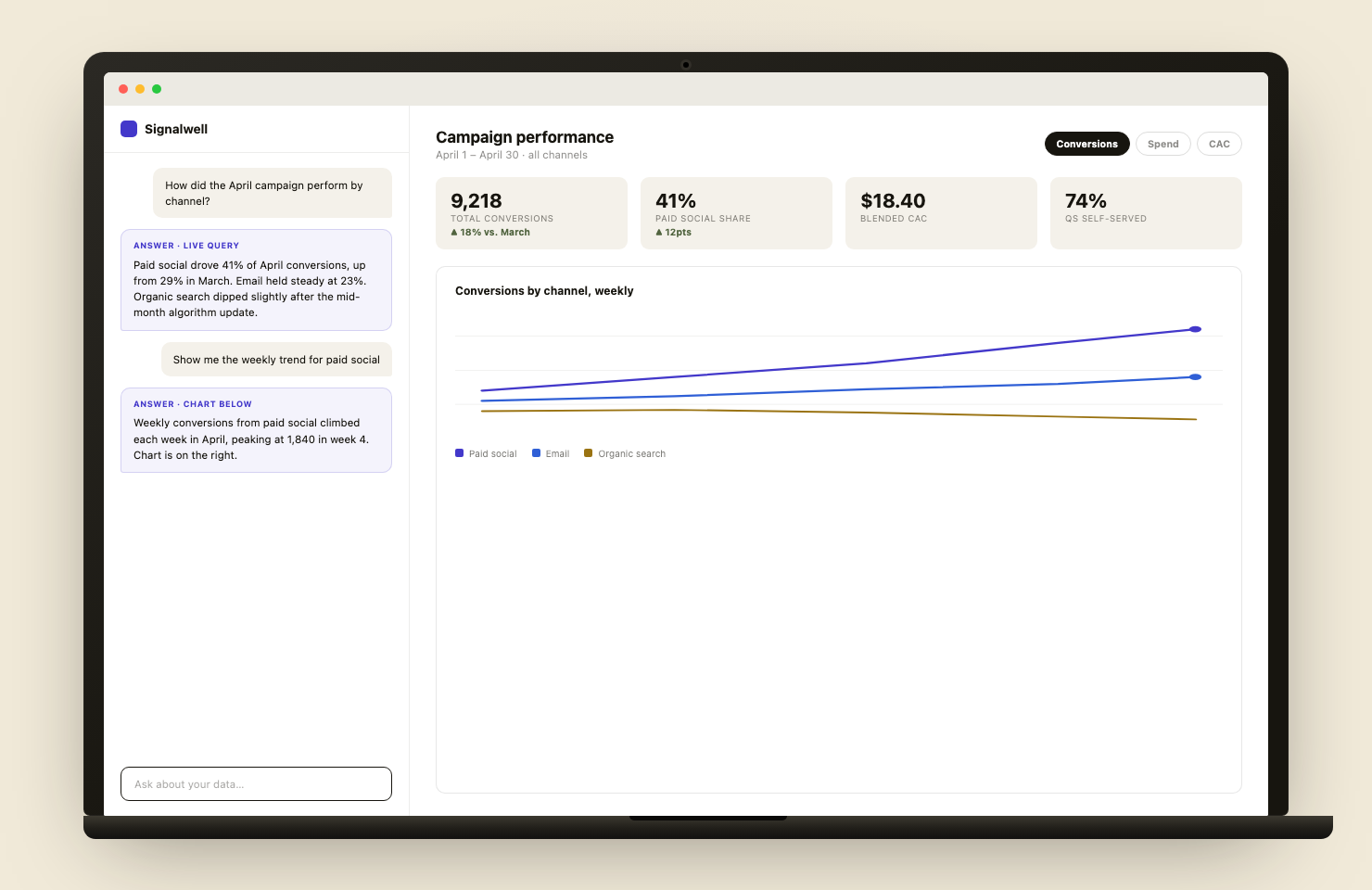
Hybrid retrieval (BM25 + dense) over private corpora with citations and an eval harness. Beats off-the-shelf legal / medical AI on the same data.
Drafting & content workflows
AI writes a first draft (email, SOP, summary, report); a human edits and accepts. Wins the time without losing quality.
Document & vision AI
OCR + structured extraction for invoices, contracts, claims, ID checks. Image classification, document understanding, voice transcription.
Internal copilots
A team-facing copilot that knows your data, your APIs, your runbooks. Slack-first or embedded inside your admin.
Cost & latency engineering
Routing between cheap and expensive models, prompt caching, request batching. AI costs that scale linearly, not like a startup horror story.
04/ Why this
What you get back.
↓ outcomes
What you get back.
01
Ships in three weeks
Working AI surface in your product on a staging URL you can poke. Not a slide deck, not a demo.
02
Evals from day one
Every prompt change is measured against a labelled test set. You ship improvements with evidence, not vibes.
03
Costs you can predict
We engineer for token efficiency before we engineer for cleverness. Monthly inference cost stays inside the model you wrote into your forecast.
04
No lock-in
Built on standard SDKs and your own infra (or ours, until handoff). Swap providers in a day, not a quarter.
Depends on the workload. OpenAI for general-purpose reasoning and cheap tier-1 latency. Anthropic Claude for nuanced writing, long context, and tool-use. Gemini where the customer is already on GCP. Self-hosted Llama or Mistral via vLLM when compliance or latency demand it. We benchmark on your actual workload before recommending.
Can you fine-tune a model on our data?
Yes, with caveats. We do LoRA / QLoRA fine-tunes on open-weight models when the task is narrow, repetitive, and benefits from a small specialised model. For most use cases, well-engineered prompting + retrieval beats fine-tuning at a fraction of the cost. We tell you which one fits your problem.
Do you support private / on-prem deployment?
Yes. We deploy self-hosted models with vLLM on your AWS, GCP, or bare-metal infra. Used for regulated industries (legaltech, healthtech, finance) where data cannot leave the perimeter.
How do you measure quality?
We build an eval harness alongside the feature. Twenty to two hundred labelled examples per task, run on every prompt or model change. Hooked into CI so a regression blocks deploy. Tools we use: LangSmith, Langfuse, Promptfoo, Braintrust, or hand-rolled pytest.
↗ Start a project
Working on ai integration? Let's talk.
Tell us about the workflow you want to fix, the bottleneck you want gone, or the product you want shipped. We come back within 24 hours, usually with a few sharper questions.