Six-week projects beat six-month projects
Why we deliberately scope our engagements down to six weeks, and what we throw out to make it work.
The trap everyone recognizes
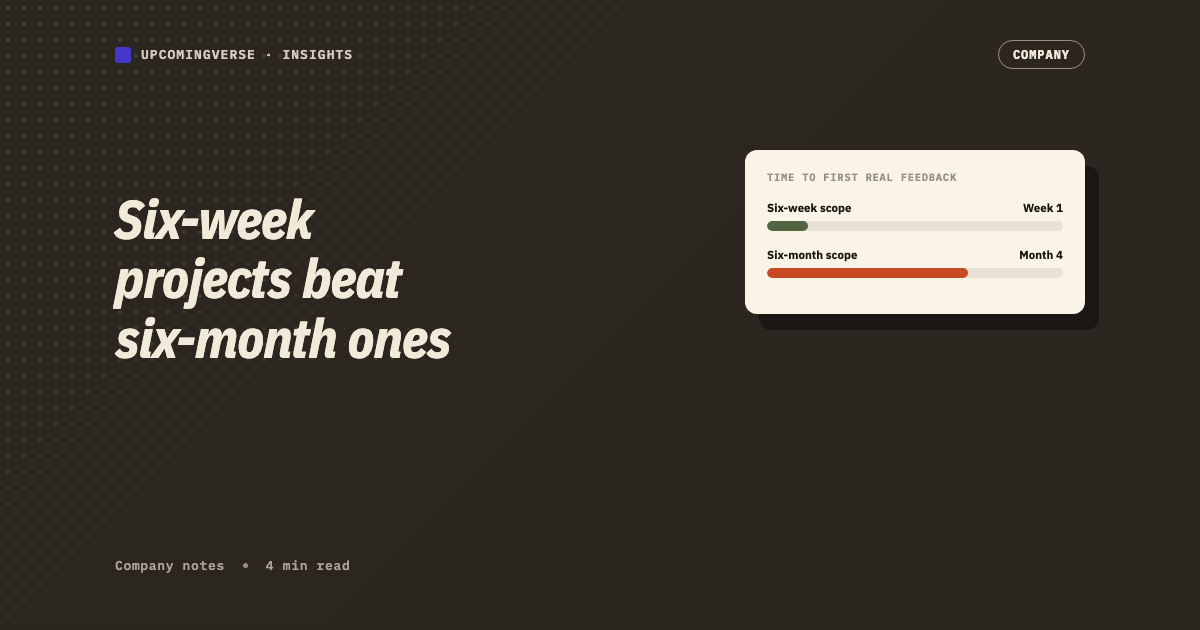
Every team knows the six-month project trap. Scope expands past what anyone scoped at kickoff, energy fades somewhere around month three, and what finally ships looks nothing like what everyone was excited about in week one, because six months is long enough for the excitement to be replaced twice over by whatever’s most urgent that week.
Our default engagement is six weeks. That’s not a marketing line, it’s a discipline we hold even when a client would happily sign up for longer, because longer is usually worse for them too.
What a six-week constraint actually forces
We have to say no, early and often. A six-week scope is a vicious filter. Roughly half of what gets requested at kickoff gets cut in week one, and in our experience it’s reliably the features nobody actually needed, the ones that sounded important in a planning meeting and would have sat unused after launch. Six months doesn’t force that conversation. Six weeks does, immediately, because there’s nowhere to hide an unnecessary feature.
We have to pick the riskiest 20% first. Whatever part of the build is most uncertain (a tricky integration, an unproven UX pattern, a performance question nobody’s tested) gets built first, even ugly, even before anything else is polished. The goal in week one isn’t a nice-looking demo, it’s proof that the scariest unknown actually works. A six-month timeline lets teams defer the scary part to month four, when there’s no runway left to recover if it doesn’t work. A six-week timeline makes that deferral impossible.
We have to demo every Friday, no matter what state we’re in. See our note on how we run weekly demos. A six-week clock makes that cadence non-negotiable, because there’s no slack in the schedule to absorb a quiet week.
What we deliberately throw out to make it work
Pixel-perfect mockups before there’s working software to react to. Architecture documents long enough that nobody actually reads them end to end. Feature lists past twenty items, because a twenty-first item on a six-week clock is really a request to cut something else, whether anyone says so out loud or not.
What a six-week engagement actually looks like
Week one ends with the riskiest part proven, ugly but working. By week three, the core flow is end-to-end functional, missing polish but demoable live. Weeks four and five are almost entirely the client’s own team using it and surfacing what’s actually wrong, which is always different from what was predicted in week one. Week six is fixes, polish, and handoff documentation (see our note on the runbook, which starts in week one too, not week six).
What happens at the end
A scoped thing that ships, plus a real decision: extend for another six weeks with a new, re-scoped goal, or stop here, because the thing that shipped is actually enough. Both are good outcomes. A six-month contract rarely offers that second option, because by month six there’s usually too much sunk cost and too little clarity left to call it done on purpose.