Hiring senior engineers in 2026
Where good engineers actually come from, and how we filter without breaking ourselves.
What “senior” means here, specifically
We don’t use “senior” as a title inflation exercise. On our team it means three concrete things: the person can take an ambiguous problem and scope it without hand-holding, they can be trusted with production access and a client-facing Slack channel on day one, and they’ve shipped something that broke in production and can talk precisely about why, what they changed, and what they’d do differently. Years of experience is a weak proxy for all three. We’ve hired five-year engineers who clear this bar easily and ten-year engineers who don’t.
The process
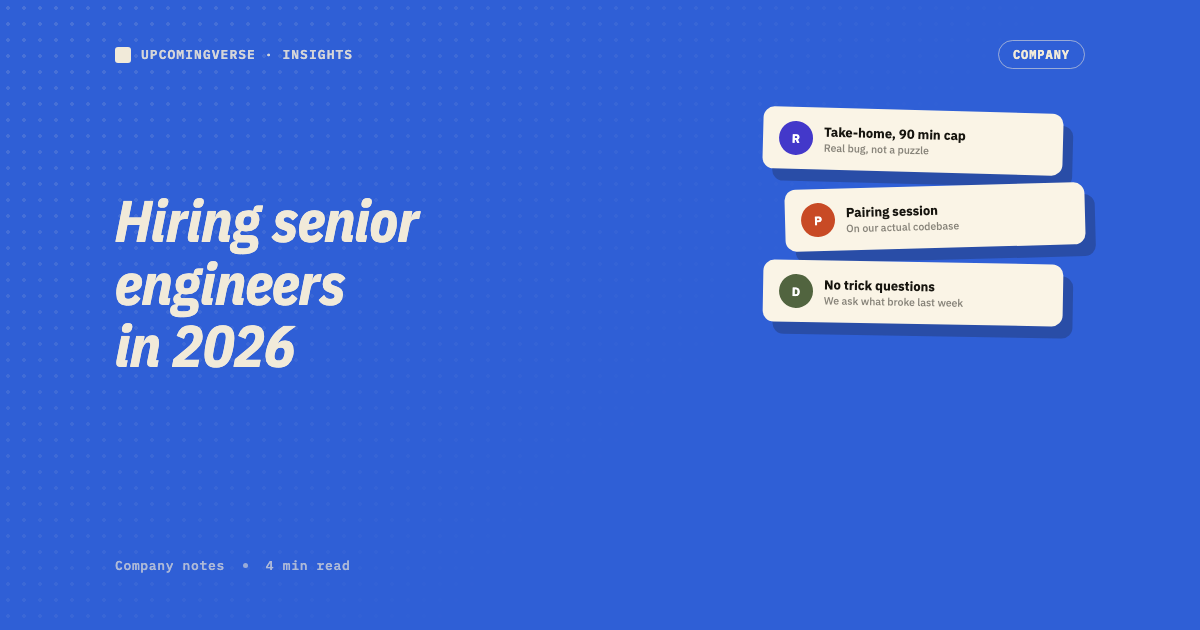
A real take-home, capped at 90 minutes. Not a brain-teaser, not FizzBuzz. A genuine, scoped bug or small feature from a category of problem we actually encounter, with a hard time cap so it doesn’t eat someone’s weekend and doesn’t reward whoever has the most free time, just whoever can navigate unfamiliar code fastest under a real constraint.
A pairing session on our actual codebase. Not a whiteboard, not LeetCode. We sit down together on a real piece of our stack and work through something together, because the way someone asks questions, pushes back, and reasons out loud under mild real-time pressure tells us more in forty minutes than a week of take-homes could.
No trick questions. We don’t ask what a candidate would do in a hypothetical crisis. We ask what actually broke on their last project, what the fix was, and what they’d change about the system to prevent it next time. The answer to that question is almost impossible to fake convincingly, and it’s a direct read on the judgment we’re actually hiring for.
Red flags we’ve learned to take seriously
A candidate who can’t describe a production incident they personally caused. Everyone senior enough to matter has broken something real; the absence of a story usually means either very little real ownership, or an unwillingness to own mistakes out loud, and both are disqualifying for the kind of trust this role requires.
A take-home that’s technically correct but ignores the actual constraint we gave. Scoping discipline is the job, not a bonus skill, and the take-home is designed specifically to test for it.
Discomfort with being told “that’s not how we’d do it” during the pairing session, followed by digging in instead of engaging with the reasoning. We’re not looking for instant agreement, we’re looking for someone who can disagree productively and still move forward.
What we offer in return
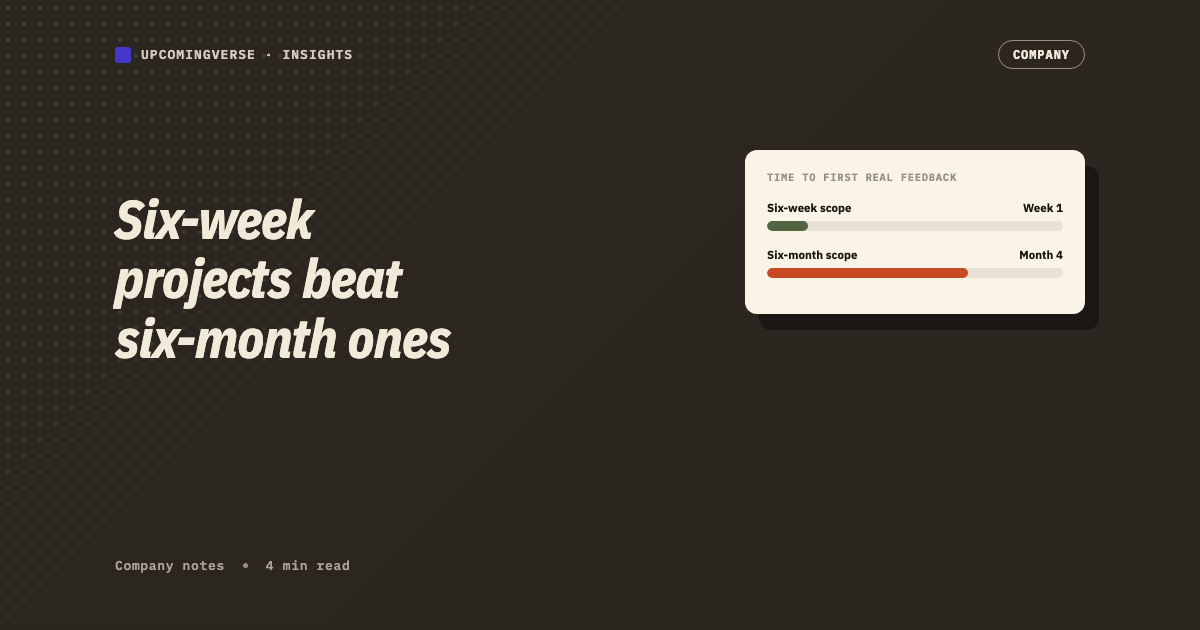
Full timezone flexibility: our team spans multiple continents and overlaps whatever working hours a client needs, so we hire the same way, for overlap with the team and the client, not for a specific office hour. Real ownership from week one: no six-month ramp sitting on tickets nobody cares about before touching anything that matters. And a six-week default project cadence (see our note on why six-week projects beat six-month ones) that means a new hire sees a full project ship, end to end, within their first month or two, not their first year.
Are we hiring right now
If this sounds like your kind of work, email us. We read every message personally, and if there’s a fit, the process above is exactly what you’ll go through, nothing hidden, nothing extra.