How we run weekly demos that don't waste time
The industry cliché is "weekly demos." Most of them are bad. Here's the structure we use.
The rule
No slides. If there’s nothing real to show, that’s the finding, not something to paper over with a deck. The meeting exists to look at working software, not to talk about working software.
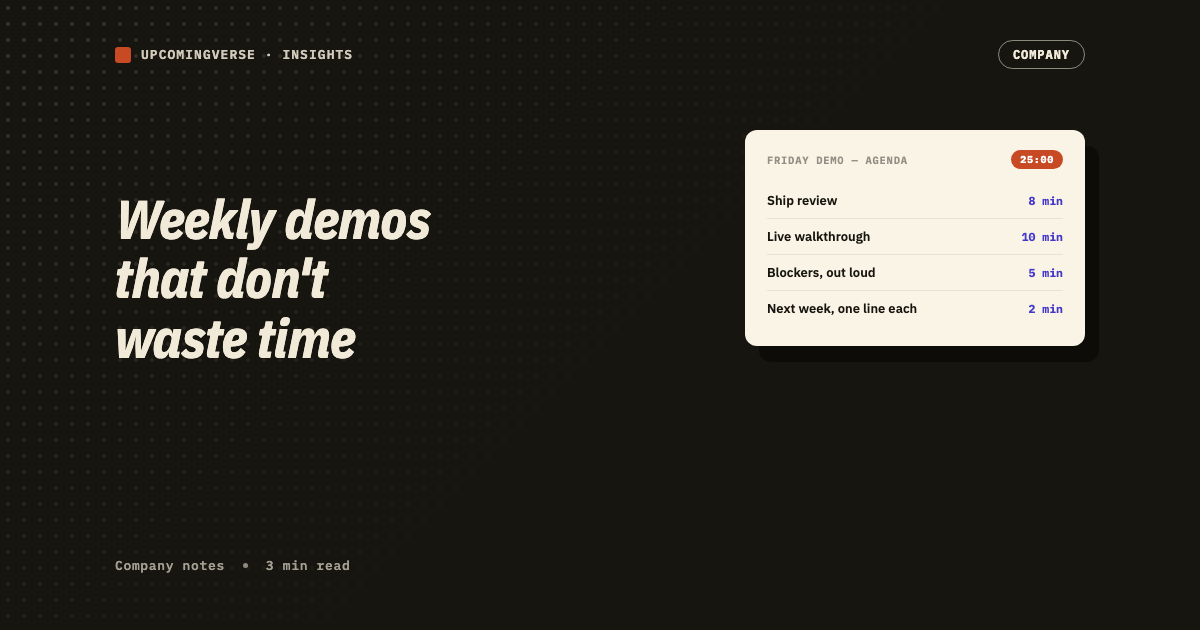
The agenda, in full
Ship review, 8 minutes. Whatever shipped this week, demoed live, from whoever built it. Not a changelog read aloud, an actual click-through. If it’s not stable enough to click through live in front of the team, it’s not stable enough to call shipped yet, and that’s useful information to surface on a Friday, not find out from a client the following week.
Live walkthrough, 10 minutes. The thing that’s closest to done but not yet shipped. This is where problems get caught early, because someone outside the work sees it fresh and asks the question the builder stopped being able to ask after three days inside it.
Blockers, out loud, 5 minutes. Said in the room, not buried in a project management tool nobody checks until standup. If someone’s stuck, the whole team hears it in real time and someone can usually unstick them before the meeting ends.
Next week, one line each, 2 minutes. Not a plan, a commitment. One sentence per person about what ships by next Friday. Short on purpose, so it’s actually said out loud and actually remembered, instead of written somewhere and forgotten.
Twenty-five minutes, every Friday, no exceptions for a slow week.
Who’s in the room
Everyone actively building that week, plus the client where the engagement allows it. Having the client in the room for at least part of it changes the incentive structure of the whole week: nobody wants to walk in with nothing real to click through, so the pressure to have something real by Friday does more to keep a project on track than any status report would.
What we explicitly ban
Status updates disguised as demos. “I made progress on the backend” is not a demo, it’s a sentence, and it belongs in the blockers section if it belongs anywhere. Slides summarizing work instead of showing it. Any meeting that runs long because someone wants to explain architecture instead of clicking a button. If the architecture needs explaining, that’s a separate, scheduled conversation, not a tax on everyone else’s Friday.
Why this works for remote teams specifically
A tight, slide-free, live-demo format travels well across timezones because it’s short, it’s the same structure every week so nobody has to guess what’s expected, and it produces a forcing function (something clickable by Friday) that doesn’t depend on everyone being in the same room, or even the same day, to feel the pressure of it.