What AI agent development actually costs in 2026
Nobody will give you a real number upfront, including us. Here's what actually drives the cost, so you can tell a fair quote from a guess.
Why nobody gives you a real number upfront
Every agency, including us, answers “how much does an AI agent cost” with some version of “it depends,” and it’s tempting to read that as evasiveness. Mostly it’s honesty. A single-intent agent reading from one API is a different project than a multi-agent system writing to five systems of record, and quoting a flat number before scoping either one is a guess dressed up as a quote.
That said, “it depends” isn’t useful on its own. Here’s what it actually depends on.
The variables that move the number
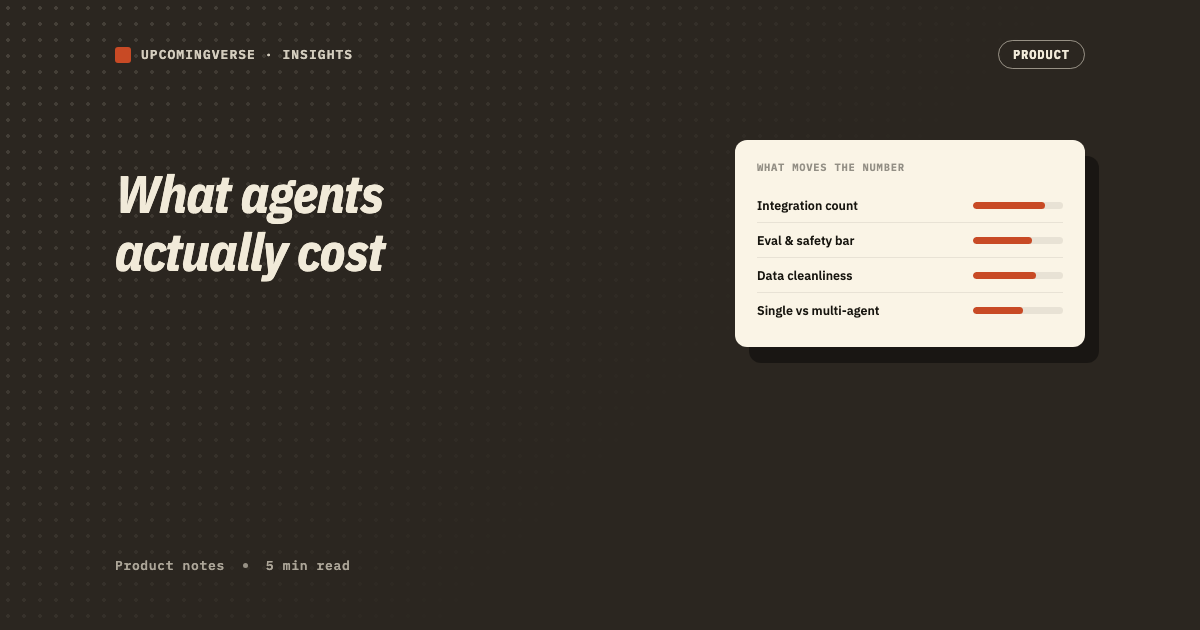
Number and complexity of integrations. An agent that only reads from one well-documented API is cheap to wire up. An agent that needs to read and write across a CRM, a billing system, and an internal tool with no API (meaning someone has to build one) multiplies both the build time and the number of ways it can quietly break.
How much eval and safety work the use case demands. An internal tool drafting Slack summaries can ship with a lighter eval harness than an agent that sends customer-facing emails or touches billing. The eval and guardrail work scales with the cost of a wrong answer, not with how impressive the demo looks.
Whether the data is clean. A huge, usually invisible cost driver. If the underlying data an agent needs to reason over is messy, inconsistent, or spread across systems that don’t agree with each other, a meaningful chunk of the project is data cleanup before the agent logic even starts.
One agent vs. a multi-agent system. A single well-scoped agent is a few weeks of focused work. A planner-worker-critic system with multiple specialized agents, shared context, and orchestration logic is a materially bigger build, and the complexity doesn’t scale linearly with the number of agents.
Ongoing inference cost, which is separate from build cost. The build is a one-time number. Running the agent costs money every time it runs, and that cost depends on model choice, prompt length, and volume. A good build includes cost-per-run tracking from day one (see the boring parts of an AI agent that actually matter) specifically so this number doesn’t surprise anyone a month in.
What a real quote looks like
A real quote comes after a scoping conversation, not before one, and it should be able to point back to the specific variables above: how many integrations, what the eval bar needs to be, whether the data needs cleanup first, whether this is one agent or several. If a vendor gives you a number in the first call before any of that is discussed, that number is a guess, and guesses tend to be either padded to cover the agency’s risk or lowballed to win the deal and expanded later.
Why we scope in six weeks instead of quoting a project total
Our default engagement is a six-week, fixed scope (more on why in six-week projects beat six-month ones), priced for that defined scope, not an open-ended “AI agent project” with a number attached before anyone has looked at your actual systems. It’s a smaller commitment to get a real quote on, and it gives you a working result to evaluate before deciding whether to continue.
If you want an actual number for your situation, the contact form gets you a real quote based on your actual scope, not a guess.