
Working with a remote AI team in India: what clients actually ask
The real questions US and UK clients bring to a first call, answered directly instead of danced around.
The questions, asked directly
We’re based in Indore, India, and most of our clients are not. Every first call with a US or UK prospect eventually gets to a version of the same handful of questions, usually asked carefully, sometimes not asked at all even though they’re clearly on someone’s mind. Here they are, answered directly.
“Will someone be awake when something breaks?”
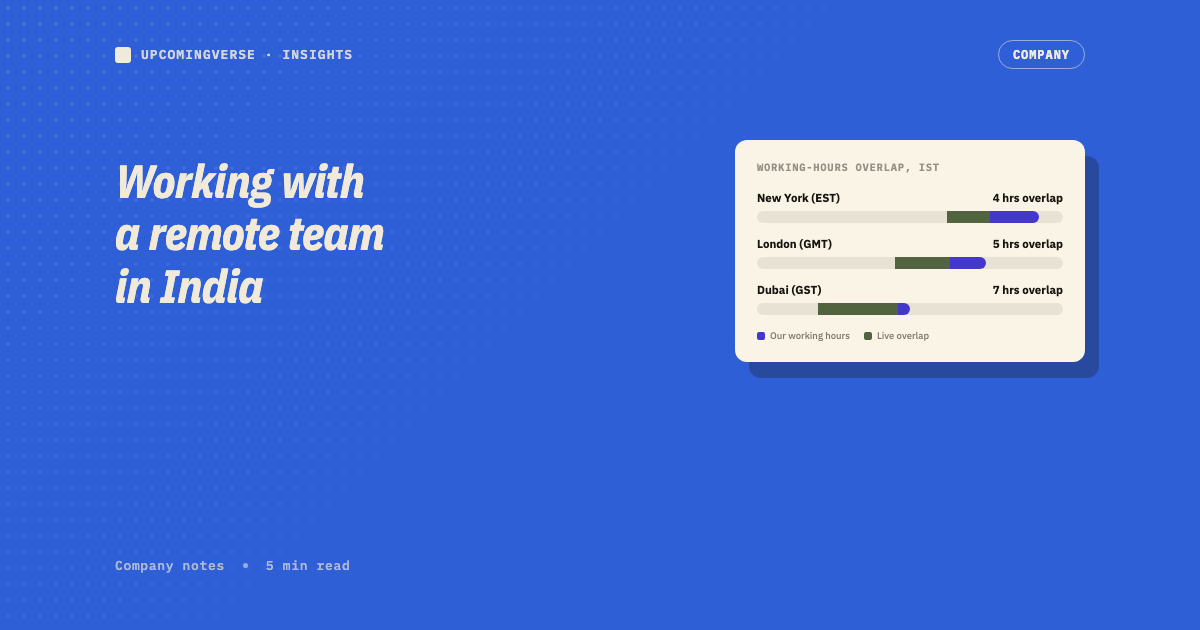
Our lead engineers structure their hours to overlap your working day, not the other way around. That’s a deliberate hiring and scheduling choice, not a lucky accident, because “we’re technically in the same project” isn’t useful if nobody is reachable when your team is actually working. For most US and UK clients that means real-time Slack availability during your morning and early afternoon, with async handoff covering the rest.
“Who owns the code and the IP?”
You do, fully, from day one. This is written into every contract, not implied. You get a clean repository with full history, documentation, and a runbook, delivered in a way that means no other team, including a future version of us, can claim any stake in it.
“How do we actually pay an India-based team?”
Standard international wire or a payment platform like Wise or Deel, invoiced in USD or GBP depending on what’s simpler on your end. Nothing unusual here, and we handle the currency conversion on our side, not yours.
“Will communication be a problem?”
The honest answer is that the main communication risk on a distributed project is almost never accent or English fluency, it’s whether the team writes things down. We default to async-first documentation: every decision, every scope change, every demo gets written up, not just said out loud in a call that only four people were in. That habit matters more for a successful remote engagement than timezone overlap does, and we’d say the same thing to a client considering a team two timezones away as one considering a team eight away.
“Is the quality actually comparable?”
We’d rather answer this with evidence than reassurance: see our case studies, each with the actual team size, timeline, and outcome stated plainly, not dressed up. India has a deep, mature software engineering talent pool, and the deciding factor on any given project is the specific team you’re hired to work with, not the country on the invoice.
“What happens if this doesn’t work out?”
Our default engagement is six weeks (see why six-week projects beat six-month ones), specifically so that a bad fit is a six-week problem, not a six-month one. You get a working result or a clear “this isn’t working” signal fast, either way, with a codebase you own regardless of what you decide next.
The actual difference that matters
The distance that affects an engagement isn’t geographic, it’s whether the team writes things down, shows up when they say they will, and hands over something you can actually run without them. We’ve found that distinction matters far more than which city either side is in. If you have other questions along these lines, ask us directly, we’d rather answer them in the first call than have you wonder about them through the sixth.