Django still wins for AI-first products
In 2026, Django is the unfashionable choice that keeps winning. Here is why we pick it for most AI products.
The instinct, and why we resist it
The instinct on a new AI product is to reach for the lightest possible backend: FastAPI, a couple of route handlers, a vector store client, done. It feels right because the interesting part of the product is the model call, and everything else feels like plumbing you’d rather not think about.
That instinct is correct for a weekend prototype. It’s wrong for anything that has to survive contact with real users, real data, and a real on-call rotation. Past the demo, the plumbing is most of the work, and Django already built most of it correctly a long time ago.
The admin is not a toy
Every AI feature eventually needs a human in the loop: someone reviewing flagged outputs, retrying a failed job, checking what the agent actually did last Tuesday at 2am. Django’s admin gives you that for free, generated straight from your models, with search, filters, and inline editing, on day one. Teams that skip Django end up hand-rolling a worse version of this exact tool six months in, usually under pressure, usually after an incident.
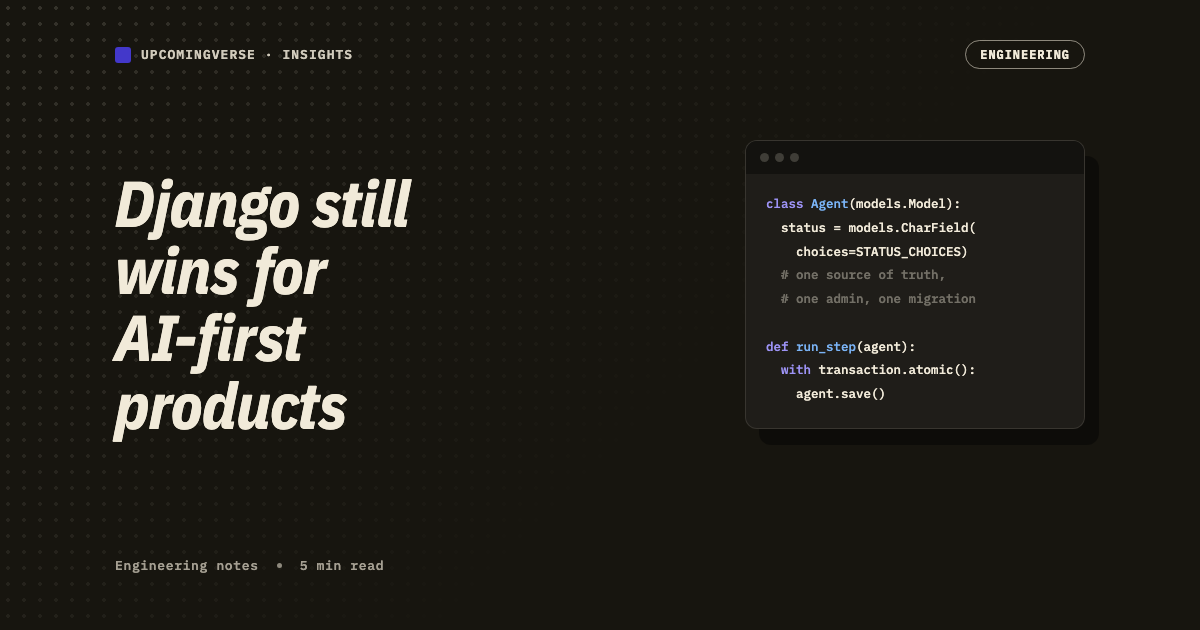
class AgentRun(models.Model):
    status = models.CharField(choices=STATUS_CHOICES, default='pending')
    input_payload = models.JSONField()
    output_payload = models.JSONField(null=True, blank=True)
    cost_cents = models.PositiveIntegerField(default=0)
    retries = models.PositiveSmallIntegerField(default=0)
Four fields, and the admin already gives an ops lead a filterable table of every run, its cost, and its retry count, with zero custom frontend code.
The ORM makes idempotency boring
AI pipelines retry constantly: a model call times out, a rate limit trips, a worker restarts mid-job. Django’s transaction.atomic() blocks and unique constraints make “don’t process this twice” a database guarantee instead of an application-level habit someone has to remember. We lean on this constantly: every agent step writes its result inside a transaction keyed to an idempotency token, so a retried job either does nothing or does exactly the same thing, never something slightly different.
Migrations are the part nobody wants to improvise
An AI product’s schema changes fast early on: new fields for a new eval dimension, a new table for a new agent type, a column to track which model version produced which output. Django’s migration system handles this with a single command and a reviewable file in your pull request. Hand-rolled schema management, or worse, a schema-less document store that “doesn’t need migrations,” tends to feel fast for the first month and turns into archaeology by the third.
Background jobs, auth, and the rest of the batteries
Celery or Django-RQ slot into Django cleanly for the queue-based work every agent system needs: long-running generations, scheduled digests, retry-with-backoff logic. Auth, permissions, and session handling, needed the moment there’s a team dashboard and not everyone should see everything, come included instead of bolted on. None of this is exciting. All of it is the difference between a six-week build and a six-month one, because it’s already been debugged by thousands of production deployments before yours.
Where we don’t use Django
The model-calling layer itself usually doesn’t touch Django at all, it’s a thin, swappable client wrapping whichever SDK fits (OpenAI, Anthropic, a self-hosted vLLM endpoint), so switching providers or models is a config change, not a rewrite. Django owns the state, the admin, the jobs, and the data. The model is just another external service it calls. That separation is what lets us swap a model version on a Friday without touching the parts of the system that actually have to be reliable.