n8n vs Zapier vs Make vs Temporal: picking the right automation tool
Four tools that all claim to do 'automation.' They are not interchangeable, and picking wrong costs you months.
The real question isn’t “which is best”
All four tools get pitched as “automation platforms,” which makes them sound interchangeable. They aren’t. The right choice depends on who maintains the workflow after you ship it, how much it costs at your actual volume, and what happens when a step fails at 2am. Here’s how we actually choose, project by project.
Zapier: fastest to a working demo, most expensive at scale
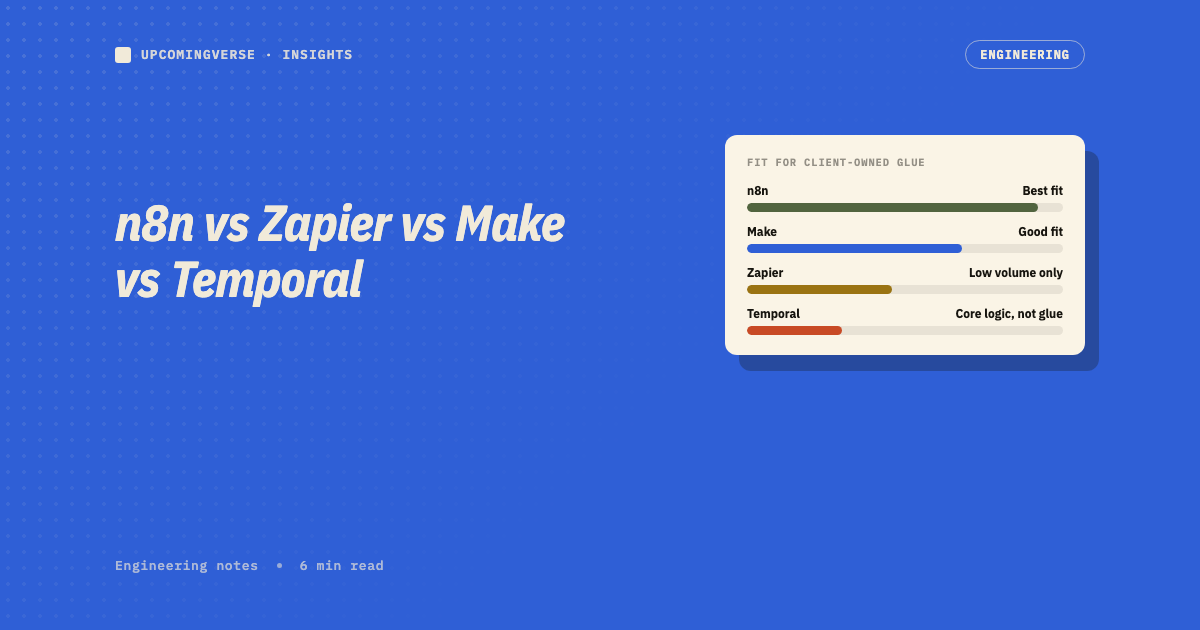
Zapier is the right call when a non-technical person needs to connect two SaaS tools this afternoon, with zero engineering involvement. The app catalog is enormous and the builder is genuinely easy. The tradeoff shows up at volume: pricing scales per task, and a workflow that runs a few thousand times a month gets expensive fast. We reach for Zapier for genuinely simple, low-volume glue (a form submission triggers a Slack message), and almost nowhere else.
Make (formerly Integromat): more power than Zapier, still hosted
Make gives you more control than Zapier, branching logic, data transformation, error handling, at a better price point for moderate volume. It’s still a hosted, proprietary platform, so you’re building inside someone else’s black box. We use it for mid-complexity integration work when a client specifically wants something their own ops team can read and modify without engineering, and Zapier’s logic model is too limited for the branching the workflow needs.
n8n: our default for client-owned automation glue
n8n is open source and self-hostable, which means a client can see exactly what a workflow does, run it on their own infrastructure, and never be locked into our continued involvement to keep it alive. The visual builder is readable enough that a client’s ops lead can open an existing flow and understand it without us in the room. We wrote about specific automations we’ve shipped on n8n if you want concrete examples rather than a feature list. The honest limitation: it’s built for integration and orchestration glue, not for high-throughput, code-reviewed, mission-critical business logic. Pushing n8n past that point is where teams get burned.
Temporal: when the workflow is the product, not glue around it
Temporal is a different category entirely: a code-defined, durable execution engine built for workflows where correctness, retries, and long-running state genuinely matter, think a multi-day order fulfillment process or a multi-step agent pipeline with real money or real consequences on the line. It has a real learning curve and is overkill for a Slack notification. But when a workflow absolutely cannot silently fail or silently double-run a step, Temporal’s guarantees are worth the setup cost. We reach for it when the automation is core product logic, not integration glue, which is also roughly where the boring parts of an AI agent that actually matter start to apply directly.
A rough decision rule
Low-volume, non-technical owner, simple two-app connection: Zapier. Moderate complexity, still wants a no-code owner, decent volume: Make. Client-owned integration glue across multiple internal and external tools, needs to survive without us: n8n. Core product workflow where a missed retry or a duplicate side effect is a real incident: Temporal (or Prefect/Airflow if it’s data-pipeline shaped rather than event-shaped).
What we actually ship
Most engagements end up using two of these together: n8n for the client-facing integration layer their team can see and maintain, and Temporal underneath for whatever part of the system can’t tolerate a silent failure. Picking one tool for everything is usually a sign the choice was made before anyone looked closely at what the workflow actually needs to guarantee.